
Much has been written following the Supreme Court’s decisions in AT&T Mobility LLC v. Concepcion, 563 U.S. ____, 131 S. Ct. 1740 (2011); Oxford Health Plans, LLC v. Sutter, 569 U.S. ____, 133 S. Ct. 2064 (2013); and American Express Co. v. Italian Colors Restaurant, 570 U. S. ____, 133 S. Ct. 2304 (2013). Yet, in this crowded field, there is a need for clear thinking on the most pragmatic issues: deciding whether to adopt arbitration and, if so, how to draft pre-dispute mandatory arbitration agreements.

The threshold question is whether your organization should have arbitration agreements. Some employers adopt arbitration agreements without a considered cost-benefit analysis of whether its advantages (e.g., reduced costs, faster resolutions, greater privacy, no jury, increased predictability, etc.) will be realized. Others do this analysis but then fail to tailor arbitration to meet their organization’s needs. As a result, there are employers who have been disappointed to discover that their arbitration systems yield a greater number of claims, significant expenses, no guarantee of arbitrator expertise, and no effective appellate review of unsatisfactory arbitration decisions.

More sophisticated analysis and a deeper appreciation for the flexibility of arbitration can avoid those disappointments. Here are the key questions to start determining what type of arbitration agreement (if any) fits best for your organization:

  • Has your organization been facing too many employment-related claims?
    • What types of claims?
    • Where are those claims being brought (because arbitration cannot short-circuit government agencies like the NLRB or the EEOC)?
    • Are those claims being brought on an individual, joint, collective or class basis?
    • By which classifications of employees?
  • How important is privacy in the outcome and in the adjudication process?
  • How important is the absence of a jury?
  • Does the absence of meaningful appellate review make arbitration untenable?
  • What are your current transactional costs in handling employment-related claims?
    • What are your objectives to reduce those costs?
    • Are those objectives reasonable in light of modern arbitration practice?
  • Will arbitration increase the volume of claims or otherwise adversely impact corporate culture or morale?
  • Would a simple jury waiver work better than arbitration?

Depending upon the answers to these inquiries, you can custom fit arbitration to your best interests. Upon closer analysis, you might decide that universal arbitration agreements in applications, handbooks, and/or employment agreements are just right. Alternatively, you may decide to limit the classifications of employees and/or the types of claims for which arbitration is required.

There are precious few limits legally: e.g., an arbitration agreement must provide for a neutral arbitrator, it must limit the costs of arbitration to employees, and it must not contain a limit on statutorily available remedies. Thus, there is a real opportunity for creativity and customizing. Indeed, asking the right questions might even prompt consideration of pre-dispute agreements that have no arbitration but which waive the right to a jury trial and agree to a bench trial (perfectly proper) or waive any right to bring a class action (which federal courts and some state courts will enforce).

Evolving legal developments have now given employers the option to customize. There is no reason to wear hand-me-downs anymore. This is decidedly one of those places where one size does not fit all and where you owe it to yourself and your organization to get custom-fitted.

It is now illegal in New York City for employers to discriminate against job applicants based on their employment status. This June 2013 amendment to New York City’s Human Rights Law (“NYCHRL”) — a law already relished by plaintiffs’ attorneys for its extraordinarily broad definition of discrimination — defines “unemployment” as “not having a job, being available for work, and seeking employment.”

This is the first law defining unemployment status as a protected class along with the more familiar litany of protected classes: age, race, creed, color, national origin, gender, disability, marital status, partnership status, sexual orientation and alienage/citizenship status. It is definitely not the last. There are over two dozen pending proposals for amendments to federal, state and local laws in order to ban discrimination against the unemployed.

Other jurisdictions have joined this seismic shift but along more narrow lines. For example, the states of New Jersey and Oregon as well as the City of Chicago have banned job advertisements stating that the unemployed need not apply. And the District of Columbia has made it unlawful for all employers and employment agencies in the District to consider the unemployed status of an applicant in employment and hiring decisions; that law also bars employers and employment agencies from indicating in an advertisement for a job vacancy that unemployed individuals are disqualified for the position.

Critically, none of those laws – except for New York City’s — afford an unemployed job applicant the right to sue in a court of law … yet. However, in New York City, lawsuits can now be brought by either individuals or the New York City Commission on Human Rights to seek are all of the remedies available in other discrimination cases: backpay/frontpay, compensatory damages for emotional distress, punitive damages, injunctive relief, and attorneys’ fees. In contrast to Title VII, the NYCHRL has no damage cap.

Given the trend line and the historical evolution of protected categories spreading across jurisdictions (i.e., sexual orientation), wise employers are taking preemptive measures. Those include the following:

  • reviewing handbooks, job applications, and other documents to delete any overt declarations of hostility toward hiring applicants who are currently unemployed;
  • examining all job advertisements and postings (both internal and external) to scrub any language indicating that current employment is an absolute requisite for the job; and
  • training interviewers to steer away from focusing on unemployment and instead focusing on the candidate’s skills, qualifications and experience.

For most employers, unemployment per se has never been a bar to employment. Rather, it is gaps in employment which have historically been a red flag in considering applicants. Is there a difference for purpose of these new laws? Yes, but that will likely be tested in the forthcoming lawsuits.

Imagine a candidate who is currently employed but has a checkered history of being out of the labor market. His rejection is plainly legal: he is not in the protected class defined by this statute. Now, imagine his twin brother with the same checkered history but who is unemployed. That brother is in the protected class; his rejection for the history is distinct from his current unemployment but so closely related that it becomes a factual question for trial.

If that job history is a key metric in your hiring decisions, then perhaps that needs to be carefully stated to avoid – here, hum several bars along with Robin Thicke* – “Blurred Lines.” This could be done in a disclaimer on the employment application but is admittedly an adventurous solution only for those enterprises that are devoted to striking candidates with imperfect commitments to the job market.

*Who’s Robin Thicke?

Companies of all sizes, new or mature, sometimes go out of business. “California Or Bust” is legendary in American history, but “bust” sometimes happens despite everyone’s best efforts. If you are an officer or director of a company that is heading toward its final days, there is a critical wind-down task: final paychecks. The simple (but widely ignored) fact is that officers and directors can be held personally liable for unpaid wages under federal and state law in certain circumstances, and the entity’s bankruptcy status often has no effect on individual liability.

With an ongoing business, nobody cares: even if sued, the entity generally steps up to defend or indemnify. However, when that entity has no money, there can be personal exposure with zero backup due to that insolvency (and insurance policies invariably exclude coverage for this category of claims).

So what factors may make or break individual liability?

Unfortunately, this is an oft-litigated issue. See Boucher v. Shaw, 483 F.3d 613 (9th Cir. 2007) (individual managers not liable under the Nevada wage statute but vulnerable under the FLSA where those managers were responsible for overseeing cash flow, had significant ownership interests, and controlled plaintiffs’ employment conditions); Chao v. Hotel Oasis, Inc., 493 F.3d 26 (1st Cir. 2007) (individual liability upheld against corporate officer who required employees to attend meetings unpaid and thus was instrumental in “causing” corporation to violate the FLSA.) State labor laws vary but sometimes add even more risk.

What can officers and directors do to protect themselves?

Be sure that there is comprehensive compliance with wage and hour obligations. Some crucial areas for review include whether your workers are properly classified (exempt vs. nonexempt as well as independent contractor vs. employee), whether your workers are timely and fully paid for all time worked, and whether the content of your wage statements are complete.

If your organization is already experiencing financial problems or planning to wind-up operations, don’t take shortcuts. The FLSA defines “employer” too broadly to rely on assumptions that the workforce is loyal and will understand. As a reminder, that definition includes “any person acting directly or indirectly in the interest of an employer with relation to an employee.”

Specifically, in times of windup, do not defer wages, delay payroll in order to pay other expenses, or in any way shortchange the workforce in this critical period. Further, if there is risk that payroll cannot be met in the immediate future, then a reduction in hours or layoffs must be considered before employees earn wages that cannot be paid in a timely manner. The failure to do so can be personally expensive.

The “shoulder-surfer” is that insufferable snoop at Starbucks, at the airport, on the bus, or anywhere else who peers over your shoulder and observes your online moves. Exasperating as it may be to share your love of lolcats and cheezburgers with an unwanted onlooker, there are certainly times when it is appropriate for employers to do so, right?

The Illinois state legislature disagrees. In 2012, Illinois enacted a law (known as the Illinois Right to Privacy in the Workplace Act, for those of you keeping score at home) to restrict an employer’s ability to access employee social media accounts. Similar legislation has been introduced at the federal level and in 35 other states. So far in addition to Illinois, laws have been enacted in Arkansas, California, Colorado, Maryland, Michigan, Nevada, New Jersey, New Mexico, Oregon, Utah, Vermont, and Washington state.

Each of those state laws generally prohibits an employer from requiring that employees or prospective employees divulge their passwords to a social media account. Illinois, however, was clearly not impressed by these other states’ efforts and decided to go one step further: an employer also may not “demand access in any manner to an employee’s or prospective employee’s account or profile on a social networking website.” 820 ILCS 55/10(b)(1). This provision seems designed to prevent literal “shoulder surfing”: i.e., an employer cannot require an employee to show his online profile, even if the employer never asks for the actual password.

In practice, however, the ambiguities in Illinois’ new law may create headaches for employers; some of those are currently being addressed by the legislature, while others are not. For example, the law excludes information that is in the “public domain.” 820 ILCS 55/10(b)(3). But this misunderstands social media: Facebook (and similar sites) allows users to customize the privacy settings for their profile and postings – some content may be visible to everyone, some only to friends, and some to friends of friends. Which setting trips an account into the “public domain”?

The Illinois law also makes no exceptions for times when an employer might legitimately seek access to an employee’s social media whether to investigate harassment or to verify that FMLA leave has not been abused. Jaszczyszyn v. Advantage Health Physician Network, 2012 WL 5416616 (6th Cir. Nov. 7, 2012) (affirming summary judgment on FMLA interference and retaliation claim where employee was terminated after her Facebook photos revealed her spending all day at a drinking festival while on leave secured for other purposes).

Initially, the Illinois law made no distinction between personal accounts and business accounts. The law was amended on August 16, 2013, to make clear that it applies only to “personal accounts” — defined as an account used “exclusively for personal communications unrelated to any business purposes of the employer.” 820 ILCS 55/10(b)(4). Illinois employers may now seek access to a “professional account” when they have a “duty to screen employees or applicants prior to hiring”, or to otherwise comply with federal or Illinois insurance law. A professional account is one that is “created, maintained, used, or accessed by a current or prospective employee for business purposes of the employer.” Even with these amendments, however, the Illinois still fails to appreciate how social media really works – individuals frequently use the same account for both business and personal communications.

Employers who operate in multiple states must now deal with another patchwork of confusing and contradictory state laws. Here, the best option may be to differentiate between screening social media as a hiring tool and screening social media in investigations:

  • First, it is perhaps time to recognize the emerging trend and eliminate the option to seek access to an applicant’s or employee’s account, irrespective of state law (which also eliminates inadvertently identifying protected statuses such as religion or sexual orientation, which are best left unknown).
  • Second, employers should continue to strictly control access and usage of “official” social media accounts, making clear that company-sponsored accounts are to be used exclusively for business purposes. See e.g., PhoneDog, LLC v. Kravitz, No. C 11-3474, 2012 WL 273323, at *1 (N.D. Cal. Jan. 30, 2012) (denying motion to dismiss claims of intentional and negligent interference with economic advantage where employee continued to use company’s Twitter account after termination of employment).
  • Third, with respect to accessing social media in investigations of harassment, theft of trade secrets, etc., this should be determined on a case-by-case basis with guidance from corporate headquarters. There is no reason to handicap investigations in every state based on the worst-case state law.

It is important to remember that these laws do not prohibit employers from conducting general online searches about employees and prospective employees. Nevertheless, employers should still ask themselves several questions before doing so. Is there a policy in place to ensure that all employees and applicants are subjected to the same treatment – are you an equal opportunity Googler? Do the rewards of the search outweigh the risks of uncovering information about protected statuses? Do you give an employee or applicant the opportunity to explain the results of the search? Ultimately, what’s really needed is a dose of common sense: are the results of the search likely to give you information that is relevant to the job? More often than not, the answer might be no.

What all of us do—solve legal problems arising in the workplace—occasionally appears on film. Sometimes accurate; sometimes flawed; and sometimes funny. To collect those Hollywood moments, we sent our college interns (Elizabeth Hernandez, Heidi Savabi, and Chandler James) into NetFlix and YouTube to search for nominees. Now, we invite you to vote for your favorite or to submit a write-in ballot for a scene that we overlooked or ignored.

And, the nominees for best film portrayal of the world of employment law are…

Margin Call (2011): RIF

The opening scene is a large-scale RIF. Be patient and wait for Stanley Tucci to be told of his selection. Bonus points if you catch the one legal mistake; irony points if you have ever said or done (or coached anyone else on) any of the things that are done in this scene.

The Informant (2009): whistleblowing

Matt Damon illustrates in this scene some of the psychological traits commonly found in whistleblowers. As whistleblowing claims increase under SOX, Dodd-Frank, and other federal and state statutes, it is necessary to understand what motivates and drives whistleblowers as much as it is necessary to understand the legal defenses.

Up In the Air (2009): termination

This clip features George Clooney firing a long-term employee. Do not try this script: this is fiction and never happens in real life. This is the brilliant and life-saving conversation that we want to have and never do. Dream on! We aren’t as handsome as Clooney and the people across the desk NEVER have the courtesy to follow the script and have an epiphany as J.K. Simmons (playing “Bob” in this scene) does.

Philadelphia (1993): disability discrimination

Can you sound like Tom Hanks and Denzel Washington as you explain the “essence of discrimination” to decision-makers? Do you hear the echoes of another movie scene in their reading of why stereotypes are wrong?

Norma Rae (1979): unionization

Norma Rae’s employer is a case study in how NOT to respond to union activity. This film clip is grainy and looks more like a 19th century union campaign than the modern 21st century strategic campaigns that rely more on public pressure than employee pressure like the UFCW’s WalMart Watch.

North Country (2005): sexual harassment

Here, Charlize Theron’s character is subject to vile harassment while working in a male-dominated mine. Hard to believe that this occurred.  But the film itself is based on the landmark case, Jenson v. Eveleth Taconite Co., 130 F. 3d 1287, 1292 (8th Cir. 1997) which was the first class-action harassment suit in United States history.

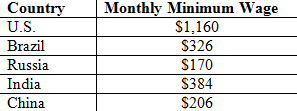
Economists have predicted that the quartet of countries known as BRIC – Brazil, Russia, India and China – will have the world’s most explosive growth in the coming decades.  Indeed,  businesses and investors have flocked to these countries in part for the natural resources of Russia and Brazil and in part for the multiplying consumer classes of India and China.  But those attributes only tell part of the story: another key reason for BRIC’s popularity is cheap labor: 

Employers are naturally attracted to those figures.  US wages are calculated based on 160 hours per month at the current Fair Labor Standards Act minimum of $7.25 per hour.  Brazil’s are described hereRussia’s Labor Code sets the minimum there.  In India, minimum wages determined at lower levels of government; this estimate is based on minimum wages in Vellore of  Rs 129.95/hour, or about $2.40/hour, amounting to about $384/month.  China follows that same pattern of local determination; this estimate is based on the minimum wage in Shanghai of 1,280 yuan/month, or $205.94/month. 

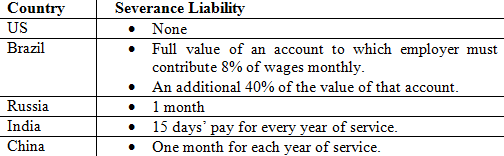
Yet, before getting into  BRIC labor markets, employers should understand the costs of getting out.  In those markets, employers face a comparative disadvantage: statutory severance.

Such BRIC severance schemes can also have collateral consequences on workforce development.  For example, employers in Spain owe 33 days’ severance per year of employment to fired workers, “[s]o it’s the young ones who get fired.” This collateral consequence applies in full force to terminations in Brazil, India and China (where longevity is a factor in calculating severance) but not at all in Russia (where longevity is a nonfactor).  As a result, savvy employers often consider using independent contractors or so-called “labor dispatch” to shield themselves from severance, social security and other liabilities. 

Yet, employers must carefully study the law of their target jurisdiction.  In China, for instance, an amended PRC Labor Contract Law requires foreign employers to hire the majority of their employees through direct employment arrangements effective July 1, 2013, thus impeding the end-run around severance obligations.  Brazil and India have comparable restrictions.

Initiating or expanding operations in the BRICs will prove highly profitable for many in the coming decades.  Those who wish to be most profitable will first canvass and understand the full range of legal obligations in the labor landscape there rather than learning through trial and error.

Two years is a long time for an employee to stay in one place. According to the US Department of Labor’s Bureau of Labor Statistics, over one quarter of all US jobs have tenures of less than two years.

Yet, in Fifield v. Premier Dealer Services, Inc., 2013 IL App (1st) 120327 (2013), the Illinois Appellate Court has just held a nonsolicitation and noncompetition covenant unenforceable for lack of consideration because the employee’s job with his employer did not last two years after he signed the covenant, even though he had received a new job in exchange for the covenant, and even though he was the one who quit.

While other states require some minimum employment term under certain circumstances, the blanket two-year requirement in Illinois now poses one of the most onerous consideration rules in the US.

In Fifield, the employee was fired by his old employer and hired by the company that acquired the old employer. The employee signed a restrictive covenant with the acquiring company and subsequently began working for it, but quit after three months to work for a competitor. When litigation ensued, the acquiring company argued it had given the employee new employment which constituted adequate consideration to enforce the covenant, but the court still treated the covenant as a postemployment agreement that requires separate consideration. In fact, the decision explicitly agrees with a federal court opinion asserting that there is no “distinction between pre and post-hire covenants.”

In light of this decision, it is necessary to think pragmatically:

1.  Avoid Illinois law where possible. In drafting restrictive covenants, employers should avoid Illinois choice of law and choice of venue provisions. Illinois courts may not give effect to such extra-jurisdictional provisions if the chosen state law is “repugnant” to Illinois law or Illinois has a greater interest in the matter than the chosen state, but if there is a plausible nexus, employers should attempt to apply that other state’s law.

2.  Employers may still require a covenant… There is nothing prohibiting an employer from firing or refusing to hire an employee that refuses to sign a restrictive covenant. O’Regan v. Arbitration Forums, Inc., 121 F.3d 1060, 1064 (7th Cir. 1997); Lambert v. City of Lake Forest, 186 Ill. App. 3d 937 (1989). Employers wishing to require a restrictive covenant can thus communicate the requirement as follows:

“You must execute this agreement to [be hired or continue] employment with the company. In consideration for the restrictions of this agreement, the company will give you [specific consideration].”

3.  …but employers must give additional consideration. Illinois courts have suggested that compensation other than employment, such as a bonus or salary increase or a promotion, may constitute adequate consideration but have offered little insight on how much additional compensation is adequate. Employers should assume that real value, and more than a de minimis amount, is necessary. Curtis 1000, Inc. v. Suess, 24 F.3d 941, 947 (7th Cir. 1994). Here are a few suggestions for additional consideration, which should be explicitly tied to the restrictive covenant:

  • bonus at the time of hire
  • stock options under First Health Group Corp. v. Natl. Prescription Administrators, Inc., 155 F. Supp. 2d 194 (M.D. Pa. 2001) (holding stock options to be sufficient consideration under Illinois law)
  • severance package or
  • salary increase and/or a promotion or enhancement of responsibilities for current employees.

4.  Understand stock deals vs. asset deals. When dealing with a transaction, purchasers in a stock deal are unlikely to face the issues in Fifield because such purchasers step into the shoes of the target as the employer and the employment relationship effectively remains status quo. Purchasers in an asset deal, however, need to hire any employees of the target whom they wish to retain. After Fifield, any job they offer is insufficient consideration if the employee leaves before two years, so the purchaser should offer something additional.

Some of these measures are unpalatable. That, of course, is precisely why Fifield is noteworthy and may not stand if the Illinois Supreme Court grants review.

In the meantime, however, it is necessary to take steps to save the restrictive covenants of those employees who fall into that quartile of Americans unlikely to stick around for two years.

Let’s start with the statistics.  Last year, there were 99,412 EEOC charges filed; 37,836 of them — more than one out of every three — asserted retaliation.  Put differently, more charges of retaliation were filed than any other protected category.  It is every plaintiff’s lawyer’s favorite play.  Why?  Let’s turn to a case study.

One of your managers, an “incredible and valuable employee” has been accused of mistreating a subordinate.  You do everything right, conduct an investigation, and conclude that there was no sexual harassment.  But, the complaining employee keeps coming back, protesting that the supervisor isn’t being fair.  You decide enough is enough, and determine that the employee just has a problem with the supervisor, and it’s best to part ways.  Not surprisingly, the employee sues, but the court agrees that there was not a hostile work environment. 

So time to pop open the champagne, right?  Not so fast: there is also a retaliation claim.  Here, you have clear complaints, followed by a termination, and collateral evidence that those complaints were a factor in the termination.  That sounds like retaliation.  That was exactly how the appellate court saw it in Westendorf  v. West Coast Contractors of Nevada, Inc., 712 F.3d 417 (9th Cir. 2013). 

The appellate court found that a litany of sexual comments — even though many were raunchy — were not severe and pervasive enough to constitute a hostile work environment.  Further, mean-spirited comments by the supervisor that were nonsexual also could not form the basis for a hostile work environment claim.  Thus, the appellate court upheld summary judgment to the employer on that claim. 

But, the appellate court majority (despite a dissent from one judge) reversed summary judgment on the retaliation claim sending it back for a full trial.  Even though Westendorf’s final round of complaints had nothing to do with sexist remarks, management’s response hit the same iceberg as the Titanic: “[we are] tired of listening to all this” and “[you] obviously had a problem getting along with [the supervisor] and that it would be best if [you] got [your] personal items and left.”

This is not just one employer having an off day or one court being difficult.  In Summa v. Hofstra University, 708 F.3d 115 (2nd Cir. 2013), a female student manager of the football team complained of sexism; the university took immediate action, including kicking the primary offender off the team, and ordering sexual harassment training for the coaching and athletics department staff; but then declined to let the student manager continue in her job.  There too, the appellate court agreed that the employer could not be held liable for sexual harassment but found the lame excuses for failing to retain this woman to be retaliatory. 

Further, the Supreme Court’s recent decision requiring proof according to traditional  principles of but-for causation will not obviate problems like those in Summa or Westendorf.  While the decision in University of Texas Southwestern Medical Center v. Nassar, 570 U.S. ___, slip op. no. 12-484 (June 24, 2013) is welcome news, it would not change the outcome in either Summa or Westendorf.

So what can we learn from this pair of recent cases?  The protected group that anyone can join and at any time —  tattle-tales, whiners, and the boy who cried wolf — is indeed the most dangerous because our frustrations with that group are longstanding (the boy who cried wolf comes from Aesop).  Accordingly, protecting your organization from retaliation claims is difficult precisely because it is often emotionally counterintuitive.

Courtesy of technology, employees can work from home or anywhere else. For organizations that have not issued a flat ban on such work, there is a glitch that no one is talking about. What if home (or “summer home”) is in another state? Or in another country?

Start with employment law. Many foreign jurisdictions will take the position that an employee working in their jurisdiction will be subject to the labor and employment law protections of their jurisdiction. For example, in Sullivan vs. Oracle, a California court took a very broad view on application of California wage & hour law to residents of other states working temporarily in California. It is just as likely that a foreign court will take the view that local labor and employment laws apply to an individual spending weeks working in their jurisdictions. And are you really willing to pay French overtime pay? Or grant German vacation? Or what about the worst case scenario: if an accident happens in a foreign land, does your workers’ compensation policy provide you with protection?

Continue with withholding obligations. In a typical secondment, most companies have safeguards in place to determine whether the secondment triggers local income tax and social security withholding obligations. But these safeguards often are overlooked when dealing with an employee who “just” wants to work from home or telecommute. Income tax treaties often permit work from a foreign jurisdiction without triggering local income tax obligations, assuming the stay does not exceed 183 days in a calendar or taxable year. But is there a treaty with that country and are all the requirements of the tax treaty met? What about state income tax withholding requirements for work from home arrangements in the U.S.? And what about social charges? Is a totalization agreement in place between the jurisdictions that exempts the foreign employer from local social charges? What if not?

Continue with immigration requirements. In many instances, the employee will be telecommuting from a jurisdiction whose nationality he/she holds. But what if — in the meantime — he or she has accepted U.S. citizenship and thus either expressly abandoned or lost local citizenship? What if the employee plans a world trip or a summer in the south of France? Are you “on the hook” if he/she performs work from foreign lands?

Move on to doing business requirements. Is the company now engaging in business in the employee’s home location when he/she is performing services there? This may be less of an issue if the employee is working for a company that has a local subsidiary or branch and thus related business licenses in that foreign jurisdiction, but what if this is not the case? More importantly, with telecommuting, do you even know where your employees are?

Finish with permanent establishment tax considerations. Foreign jurisdictions are becoming more and more attuned to companies engaging in activities in their jurisdictions without filing proper corporate tax returns. Accordingly, your telecommuting employee may have created a taxable presence or permanent establishment in the foreign jurisdiction for your entire organization. Again, a tax treaty may provide relief, but its requirements must be met. Has this been thought through? Has tax signed off on the work from home arrangement?

Companies that have said “no” to all such arrangements are receiving the same response as the Grinch who stole Christmas. But, maybe, when the multinational risks are factored in, these companies look smarter in hindsight. Before giving the quick and easy “yes” answer to telecommuters (whether permanently or “just for the summer”), your company owes it to itself to at least consider the implications.

Both the Department of Labor and the National Labor Relations Board — in separate cases – just cited a recent Supreme Court decision as their trump card. See “High Court Ruling Hurts Case Against Poster Rule, NLRB Says,” Employment Law 360 (May 24, 2013) and “DOL Says High Court Ruling Bolsters Tip Pool Rule,” Employment Law 360 (May 29, 2013). Judas Priest’s rock anthem You’ve Got Another Thing Coming kept echoing in the background while reading that decision (City of Arlington v. FCC) and answering those spurious arguments. http://www.youtube.com/watch?v=XWhInhE6emE

Karl Llewellyn famously noted that “[o]ne does not progress far into legal life without learning that there is no single right and accurate way of reading one case.” Llewellyn, “Remarks on the Theory of Appellate Decision and the Rules or Canons About How Statutes Are To Be Construed,” 3 Vanderbilt L. Rev. 395 (1950). The DOL and the NLRB choose a facile but flawed approach: look for a sound bite.

Both argue that City of Arlington means that administrative agencies always get deference. But, upon close inspection, that is not what it holds: it involves a statute that grants rulemaking authority and that also uses the phrase “reasonable period of time” which the FCC defined as either 90 or 150 days, depending on the category of application. Here, deferral is unsurprising.

What the NLRB and DOL (especially DOL since the majority cites approvingly last term’s decision rejecting DOL’s interpretations and holding that pharmaceutical reps were indeed overtime exempt under the Fair Labor Standards Act) ignore is what Llewellyn taught: context matters more than sound bites.

The majority opinion is clear: agency deference is always a case-specific inquiry:

The fox-in-the-henhouse syndrome is to be avoided not by establishing an arbitrary and undefinable category of agency decisionmaking that is accorded no deference, but by taking seriously and applying rigorously, in all cases, statutory limits on agencies’ authority. Where Congress has established a clear line, the agency cannot go beyond it; and where Congress has established an ambiguous line, the agency can go no further than the ambiguity will fairly allow.

Both the NLRB and the Department of Labor have another thing coming: the high probability that their facile arguments based on misreading this Supreme Court decision will be quickly rejected.