
Tattoos and body piercings have become increasingly prevalent in the U.S. — over 20% of adults are now tattooed. This number only will be increasing because 38% of millennials (born from 1981-1992) have tattoos, approximately half of whom have two or more, while 23% of millennials have body piercings.

Tattoos Office iStock_000044053810_LargeMore of a concern for employers, however, is that visible body art is increasing as well. This trend may be at odds with the image that an employer wishes to convey to its clients and customers, particularly given the negative stereotypes associated with body art: studies reflect negative biases against individuals with tattoos which include assumptions that they are less intelligent and attractive, and more rebellious. Not surprisingly, 60% of human resources professionals reported that visible tattoos would have a negative impact on an applicant’s chance of being hired, and 74% said the same thing about facial piercings.

Other than a few locales prohibiting “personal appearance” discrimination (discussed below), there is no overt protection for employees with body art. However, employers should be wary of inflexible prohibitions on visible body art. This is not just another dress code issue.

Litigation based on disputes over body art has arisen principally in the context of religious discrimination. For instance, in one case, a member of the Church of Body Modification – which, unsurprisingly, considers piercing a religious act – alleged discrimination after her employer, a retailer, required her to either cover a facial piercing or replace it with a clear insert; the court found in the employer’s favor, holding that the proposed accommodations were reasonable given its interest in presenting a “neat, clean and professional image.” Similarly, Swartzentruber v. Gunite Corp. upheld an employer’s requirement that an employee cover an offensive religious tattoo – a “Fiery Cross” in support of the Church of the American Knights of the Ku Klux Klan – even though other employees displayed inoffensive tattoos. 99 F. Supp. 2d 976 (N.D. Ind. 2000).

In such accommodation cases, courts will closely examine the facts on a case-by-case basis. Thus, not all employers have been successful. For instance, in EEOC v. Red Robin Gourmet Burgers Inc., the court ruled in favor of the employee; there was no undue hardship in allowing an employee to continue working with a 1/4” religious tattoo on his wrist, given its size and that the employer hadn’t objected to it for six months prior to termination. 2005 WL 2090677 (W.D. Wash. Aug. 29, 2005).

While litigation based on other protected classes is far less common, employers should recognize that body art may relate to other protected classes. There is very real a disparity in who has body art – one study found that roughly 47% of Hispanic and 33% of African-American respondents had body art, both well above the national average. Thus, it is not hard to imagine that rigid policies against body art could disparately impact one or more protected classes.

Only a few local governments – including Washington, D.C.; Madison, Wisconsin; Santa Cruz, California; and Urbana, Illinois – currently prohibit discrimination based on “personal appearance,” which would include discrimination for visible body art. Yet, even there, courts have been deferential to employers defending claims of body art discrimination, so long as the employer can proffer a “reasonable business purpose” for the rule – such as to preserve the employer’s “conservative” image – and is flexible in accommodating the body art by permitting the employee to cover it. Sam’s Club, Inc. v. Madison EEOC, 668 N.W.2d 562 (Wis. App. 2003).

Employers need to think about this issue before it hits home.

First, blanket bans on body art should be avoided; limits on employees showing body art should be [A] based on more than a general aversion to body art (but a business plan to present a “neat, clean and professional image” in customer access jobs has been sufficient to date) and [B] flexible with options to offer reasonable accommodations to employees with visible body art – such as allowing them to cover the art – rather than taking an adverse action.

Second, any policy regarding visible body art should be consistently applied to avoid discrimination claims arising from disparate application, such as in a Massachusetts case where the employer prohibited women, but not men, from displaying tattoos. Hub Folding Box Co. v. Mass. Comm’n Against Discrim., 52 Mass. App. Ct. 1104 (Mass. App. Ct. 2001).

Finally, decision-makers need to be educated to be sensitive to body art’s significance not only to the wearer (which may reflect a religious symbol or an ethnic symbol) but also to observant co-workers. See, e.g., King v. ST Aerospace Mobile Inc., 2013 WL 2635926, at *19 n.35 (S.D. Ala. June 11, 2013)(African-American employee offered evidence of Confederate flag tattoo on white co-worker as one piece of evidence in his unsuccessful attempt to identify a pattern of racial harassment).

Jack London once said “Show me a man with a tattoo and I’ll show you a man with an interesting past.” But that was a hundred years ago. Today, show me an employee with a tattoo and I will show you a manager developing ulcers.

Food allergies are widespread. Anyone who has a child, works at or with a school, or reads extensively knows that the increasing prevalence of food allergies among children is one of today’s biggest medical mysteries, not to mention a huge problem. The number of children with nut allergies has more than quadrupled since 1997, which has created a pressing need for schools to alter policies and menus. Airlines and other customer-centered businesses now also face pressure to change their policies for the safety of nut-allergic customers.

Peanut WarningAs the population with food allergies ages, the impact will spread to employers in the form of increasing numbers of requests for food allergy accommodations under the Americans with Disabilities Act (the “ADA”), which defines a disability as a “physical or mental impairment that substantially limits one or more major life activities.” 42 U.S.C. § 1202(1). This does not exclude food allergies: “major life activities” include “eating” and “breathing.” Id. And, under the ADA, employers are required to provide “reasonable accommodations” to an employee or job applicant with disability, including making a change to the job environment. 29 C.F.R. § 1609.

Individuals with food allergies certainly suffer from physical impairments that may substantially limit their abilities to eat and/or breathe. Indeed, food allergies (most famously peanut allergies) can trigger medical symptoms even without consuming the allergic substance: people with peanut allergies can go into anaphylaxis simply from breathing peanut dust. (No, I’m not a doctor, but I looked that up.)

So, what about work environments where employees share offices, work in communal spaces, or spend breaks in designated break rooms with other employees? If Smitty has a life-threatening nut allergy and the person in the next cubicle eats lunch at Five Guys every day and spends the afternoon cracking open those delicious free peanuts at her desk, is Smitty entitled to an accommodation under the ADA?

While there is no case law on this as of yet, there is guidance.

In 2009, the U.S. Department of Justice (“DOJ”) received a complaint that Lesley University violated Title III of the ADA (its public accommodations provision) by failing to provide reasonable accommodations for students with celiac disease and/or food allergies in its food service and meal plan system. DOJ concluded that there were violations; its settlement agreement, entered into in December 2012, contains instructive language that will likely guide further decisions in the area of food allergies. Indeed, the DOJ released FAQs on the settlement, helpfully titled “Questions and Answers About the Lesley University Settlement and Potential Implications for Individuals with Food Allergies” — available here if you’re interested.

While this settlement isn’t binding precedent, it suggests how such cases will be prosecuted both by the government and by private plaintiffs and offers direction that courts might take when confronted with such a case. With the range of food allergies being significant (chocolate, milk, fish, peanuts, gluten, etc.), employers can legitimately wonder whether taking Snickers out of the vending machine is the beginning, the end, or wholly unnecessary.

It is certainly possible for an allergic employee to push for a total ban (although pat down searches for hidden Snickers may be a bridge too far). A total ban is foreshadowed by the case law for public accommodations with respect to cigarette smoke. Staron v. McDonald’s Corp., 51 F.3d 353 (2nd Cir. 1995)(a total ban on smoking could be a “reasonable modification” for purposes of accommodating customers with respiratory disorders affected by cigarette smoke).

Yet, case law involving fragrance allergies suggests that far more limited accommodations in employment may be all that is required. McBride v. City of Detroit, 2008 WL 5062890 (E.D. Mich. Nov. 25, 2008), found that a total scent-free policy would be unreasonable as overly burdensome. Similarly, in 2007, the Third Circuit held that an employer had more than met its obligations to accommodate a scent sensitivity where it implemented a no-perfume policy, periodically reminded its employees about compliance with the policy, periodically cleaned office air filters, and provided the employee at issue with new air filters in her office and a fan for air circulation. Noting the employer’s extensive efforts at accommodation, the Third Circuit rejected the notion that the employer was required to provide an “absolutely odor-free environment.”

This, however, does not permit ignoring food allergies. Employers confronted with requests for allergy accommodations will need to engage in the ADA-mandated interactive process. Each allergy is unique; some trigger only upon consumption but others on proximity. Each will, accordingly, demand a unique and customized solution.

For allergies triggered by consumption, it would likely be sufficient to make sure that eating options are also available for allergy sufferers (e.g., gluten-free lunches in a cafeteria or snacks in vending machines).

For allergies that can be triggered even by proximity, the Third Circuit’s approach may be most instructive: Employers who receive requests for a nut-free workplace may be able to meet their obligation by implementing a nut-free policy and taking basic steps to implement, such as posting signs in break rooms reminding employees of the policy. It is difficult to imagine, however, that employers could be held responsible for an employee who smuggles peanut butter crackers in her purse into the office, since preventing such actions would require a level of policing that courts would likely not view as reasonable.

For some employees in some jobs, the accommodation may require moving the allergic employee. Drawing a parallel to fragrance sensitivity, Buckles v. First Data Resources, 176 F.3d 1098 (8th Cir. 1999), found that an employer had offered a reasonable accommodation by permitting an employee to relocate from any area with a fragrance triggering his sensitivity. Notably, that case also held that the employer rightly terminated that employee when, instead of exiting the area containing the irritant, he simply went home any time he thought an allergy might be triggered, because employers are not required to provide an “unlimited absentee policy.” Id. at 1101. There are limits to reasonableness!

For me, I just have James Thurber’s famous allergy that is also beyond accommodation: “I used to wake up at 4 A.M. and start sneezing, sometimes for five hours. I tried to find out what sort of allergy I had but finally came to the conclusion that it must be an allergy to consciousness.”

Restrictive covenants, in which an employee agrees for a certain period of time to refrain from working for a competitor or from soliciting away the company’s clients or employees, have become commonplace.  Companies in industries from finance to consumer products routinely request such covenants.  Some states, including California, Florida, Georgia and Texas, have statutes governing the enforceability of restrictive covenants; others rely exclusively on common law.shoesGenerally, for a restrictive covenant to be enforceable, it must be tailored – in geographic, temporal and subject matter scope – to protect a company’s legitimate business interests.  Interests worthy of protection include: (i) trade secrets; (ii) client relationships developed at the company’s expense; and (iii) an employee who provides “unique” or “extraordinary” services or skills.  It is time to focus on that forgotten category: the “unique” or “extraordinary” employee.

What Makes An Employee “Unique” Or “Extraordinary”?

There was a time when uniqueness was reserved for “musicians, professional athletes, actors and the like” where “one can fairly say that nature made them and then broke the mold.” Ticor Title Ins. v. Cohen, 173 F.3d 63 (2d Cir. 1999).  To be “unique,” one had to be in the rarefied air of Michael Jordan.

For example, in Shubert Theater Co. v. Gallagher, 206 A.D. 514, 518 (1st Dep’t 1923), the court’s analysis of “uniqueness” turned on whether the vaudeville actors at issue were “ordinary vaudeville performers, easily replaceable and not at all unique.” There, the court enjoined the actors (the famous comedy team of Gallagher and Shean: you remember them, right?) from performing for another company, finding that they were among the “headliners” in the field and that their “talent [was] peculiar and unique.”

Vaudeville is gone.  So too is that historical rule. Now, an employee doesn’t need to “Be Like Mike” to be unique:

  • An information technology employee was “unique” through the “special value” he provided “in his relationships with Microsoft personnel, cultivated partially through the use of his expense account while employed by plaintiff.” Henson Group, Inc. v. Stacy, 66 A.D.3d 611, 612 (1st Dep’t 2009).  Unlike those vaudeville headliners, everybody acknowledged that the “technical services he performed could have been done by others.”  
  • A pair of project managers at a communications firm provided unique services in supervising the production of “‘multi-media’ shows” at corporate meetings for firm clients. Contempo Commc’ns., Inc. v. MJM Creative Servs., Inc., 182 A.D.2d 351, 354 (1st Dep’t 1992).  Although Nolin and Wolkowitz may have produced a mean PowerPoint presentation, their “uniqueness” does not invoke memories of Rodgers and Hammerstein.
  • Even car salesmen may be unique. A Florida appellate court enforced Courtesy Toyota’s two-year ban on soliciting former co-workers; the car dealership had a protectable interest in preventing the loss of salespersons whom they had taught the “Courtesy way of selling cars.” Balasco v. Gulf Auto Holding, Inc., 707 So. 2d 858, 860 (Fla. 2d DCA 1998).

Practical Considerations

In light of this recent trend, companies would be well served to consider “uniqueness” to include even the current Philadelphia 76ers as well as Hall of Famers like Michael Jordan.  That “other” Michael Jordan in your company – the sales representative or tech professional – may indeed be providing unique services, even if he or she can’t drive to the basket or hit the game winning jump shot.

This, moreover, should not be an afterthought but a strategy.

First, companies should refine their vision of uniqueness.  Ticor Title Ins. v. Cohen, 173 F.3d 63 (2d Cir. 1999) tellingly recognized that the uniqueness inquiry “now focuses more on the employee’s relationship to the employer’s business.” (emphasis added).  It is not the person alone – compare Michael Jordan as a baseball player and as a basketball player – but the person in a particular business or professional context that determines uniqueness.

Second, companies should, where appropriate, include an explicit acknowledgment from the employee in the restrictive covenant agreement that he or she provides “unique” or “extraordinary” services (with as much specificity as possible).

Finally, companies should consider choice of law as well.  Given that New York has taken the lead in advancing the broadest definition of uniqueness, New York choice of law and forum provisions — where there is a sufficient nexus to the state — are desirable.  See Estee Lauder Cos. v. Batra, 430 F. Supp. 2d 158, 172 (S.D.N.Y. 2006) (upholding New York choice of law provision for employee who worked in California, where “the management and control of [the company] is entirely in New York, and a significant portion of [employee’s] responsibilities were centered in New York”).

vettaTake your cue from two leading ladies of television – Olivia Pope (Scandal) and Liz Garvey (Babylon).  In a world of instantaneous communication and open access to information, Liv and Liz are masters of crisis management.

The New York Times recently outlined how electronic court filings (especially in harassment or whistleblower cases) go viral and create a public relations nightmare: “More and more, the first court filings in gender-related suits, often allegations that inspire indignation, are winning wide readerships online before anyone steps foot in a courtroom.” NY Times (“Lawsuits’ Lurid Details Draw an Online Crowd”)(Feb. 22 2015)

If anything, that article understates the problem that many companies face in today’s world of instant access. Alan Dershowitz’s lament from the op ed page of the Wall Street Journal on January 15 emphasizes the “nightmare” from the perspective of the person falsely accused.  Although lawyers (including retired Harvard Law professors like Dershowitz) are great at legal denials, Liv and Liz understand that mere denial is lame.

Indeed, in the 21st century, bare denials sound too much like the next verse of the epic 20th century song “I did not have sex with that woman, Miss Lewinsky…” Liz Garvey opens the first episode of Babylon with an important ground rule: “The age of information control is over.” Thus, the basic premise must be that a pro forma denial, standing alone, is never the right answer. Neither is “no comment” or “it is company policy not to comment on ongoing legal proceedings.”

Once upon a time, ducking worked. For professional journalists, stories deprived of new information die like a fire without oxygen. Yet, the 21st century is the generation of the amateur journalists.   Silence is no longer the answer: the debate is no longer limited to plaintiff and defendant but now has multiple fronts as the whole world comments via social media and the internet. Damn bloggers!

Another Olivia Pope fan has been kind enough to summarize the Olivia Pope canon for crisis management. Here are some key points that Liz and Liv can both endorse:

  • Be forthcoming with the facts. Admit to what you don’t know, and own up to what you do know. Honesty is the best policy.
  • Focus on your stakeholders and address their concerns methodically…
  • Resist absolutes. Avoid using words such as always, never, least, most, etc.  Don’t let goodwill trump reality: only say publicly what you can defend factually…

Jennifer Connelly, “5 Crisis Management Tips Olivia Pope Would Endorse” (Dec. 14, 2014)

Now, come back to the core problem identified in the NY Times article: viral publication of the complaint allegations in a sexual harassment case. What’s the counter message? What’s the strategy?

First, the allegations are seldom a surprise. Demand letters and EEO charges typically precede the actual filing. If nobody thought of this, that is a separate problem. Yet, both Liz and Liv specialize in working on the fly. There must be a response TODAY.

Second, if the most salacious allegations appear for the first time in the court complaint, and were not in any prior complaint, demand letter or charge, let it be known. “Unfortunately, the plaintiff had not shared all of these allegations with the company before. Be assured that the company will immediately investigate these new allegations.”

Third, legal conservatism be damned: go public with whatever will be disclosed anyway. If the allegations were investigated and the harasser punished, say so. If the company has internal complaint procedures in place that weren’t used, say so. Vindicate the company. But don’t overstep – don’t deny when the facts are unknown.

Fourth, do not shoot the messenger by castigating the plaintiff for unrelated sins. Don’t bring up the fact that the plaintiff wasn’t cutting it or was recently counseled on performance – it won’t make the company more likable. Likewise, please don’t play the “some of my best friends are …” Here is a one minute clip where Liz Garvey illustrates this in an episode involving handling the police shooting of a black teenager.

Fifth, if there is action to take, take it. If somehow no investigation was done (which could explain the position the company is in), start it right away. It is better to say “The company is in the process of investigating the allegations,” than to say nothing at all.

Finally, there is value in emphasizing process: e.g., “our policy forbids harassment; our investigation to date discovered no harassment. If this lawsuit provides evidence that has otherwise been unavailable, then appropriate action to enforce the policy will be taken immediately.”

In sum, get out in front of the story as soon as it hits the wire – don’t wait for social media to be the judge and jury.

*Alan Wang of DLA’s Shanghai Office contributed to this article.

If you are an avid shopper, you may have noticed in the past holiday season that fewer and fewer items on the shelf had the familiar “Made in China” label.  In 2013, the International Monetary Fund (IMF) forecast that the era of cheap labor in China would come to an end soon.  (Last accessed on March 26, 2015).  For international employment lawyers dealing with China on a regular basis, this forecast does not come as a surprise.  Neither should it for you.

Chinese Flag with Protest Sign EPS10The IMF attributes the disappearing cheap labor in China to the aging of the workforce and the rapidly rising wages in China. Id. Both points are true but the underlying causes lurk in some of the employment laws that govern a workforce in China. Here is a list of the legal issues that are fueling that wage trend:

1. Two fixed terms and the employee will be pretty much untouchable.  In China, everyone is entitled to a written employment contract.  Usually, a new employee starts with a fixed-term contract of 1-3 years in duration, including a 1-6 month probationary period.   The catch is that after renewing the fixed-term contract twice, the employee will most likely be entitled to an indefinite term contract.  This means that the employee cannot be lawfully and unilaterally terminated without notice or severance except for serious violations of the company’s rules, serious dereliction of duty, criminal offense, etc.  Notably, poor performance is not one of those grounds.  Instead, the law requires that if performance issues arise, the employer must provide training or an alternative position before resorting to termination.  If the employer does not provide a “second chance”, the employee could claim illegal termination and seek double statutory severance (which is explained below) or even reinstatement.   Even assuming the employee flunks the “second chance” and the employer may legally terminate, statutory severance would still be required to be paid to the employee.

2. Statutory severance payments are almost mandatory and are expensive.  Statutory severance is mandatory in China except for rare circumstances (employee committing severe violations of company policies, engaging in criminal conduct, retirement or voluntary resignation).  The amount of statutory severance due is the employee’s monthly salary (capped at 3 times the local average monthly salary for service years after 2008; no cap for service years before 2008) x his or her years of service.  This means that for a blue-collar employee who has worked for the company in Beijing for 10 years and making the average local monthly salary (RMB 5,793), he/she would be entitled to a statutory severance pay of almost USD 10,000, even if he/she was terminated for perfectly valid performance reasons.  What’s more, in the case of termination for poor performance, in addition to the statutory severance pay, one month of pay in lieu of notice would also be required if the company wants to terminate the employee immediately.

3. Paying a 13th month salary is the norm, although not required by statute.  It behooves companies to make sure that their employment contract specifically provides that the 13th month’s salary is included in the annual base salary; otherwise, the employee could claim an extra month of salary on top of the annual salary.  Further, if the employee leaves before the end of the year, he/she will in most cases be entitled to a pro-rated amount of the 13th month’s salary, again even if the employee is terminated for not doing his job.

4.  Today, Chinese employees will fight for their legal rights.  Social media and smart phones help spread the word about what employees are entitled to.  According to data from the Hong Kong-based China Labour Bulletin, Chinese workers went on strike or protested at least 1,378 times in 2014, nearly twice the number of strikes and protests in 2013.  Workers organize through non-profits and professional associations; indeed, Beijing already has its own chapter of the Lean In organization.  Recently, a 21-year-old female college graduate, challenging an employer’s men-only job advertisement, won a high-profile gender discrimination case in China. According to media reports, the plaintiff had received an outpouring of support from the public which pressured the court in Beijing to eventually take her case.  (Last accessed on March 26, 2015).

5. Defending a labor arbitration or lawsuit in China are no longer cheap.  In coastal cities like Beijing and Shanghai, defense fees may run tens of thousands of dollars depending on the complexity of the case.  Adding to the cost are the facts that courts in China expect everything to be translated to Mandarin and that emails in and of themselves are not admissible evidence unless “blessed” by a complicated notary certification process.  Further, courts and arbitrators in China are not friends of employers, especially employers that are well-known multinational “deep pockets.”

Employers who are culturally and legally well-advised can beat the IMF’s projected trend line on labor costs in China.  But, there, as elsewhere, it will take planning to minimize the escalation of labor costs.

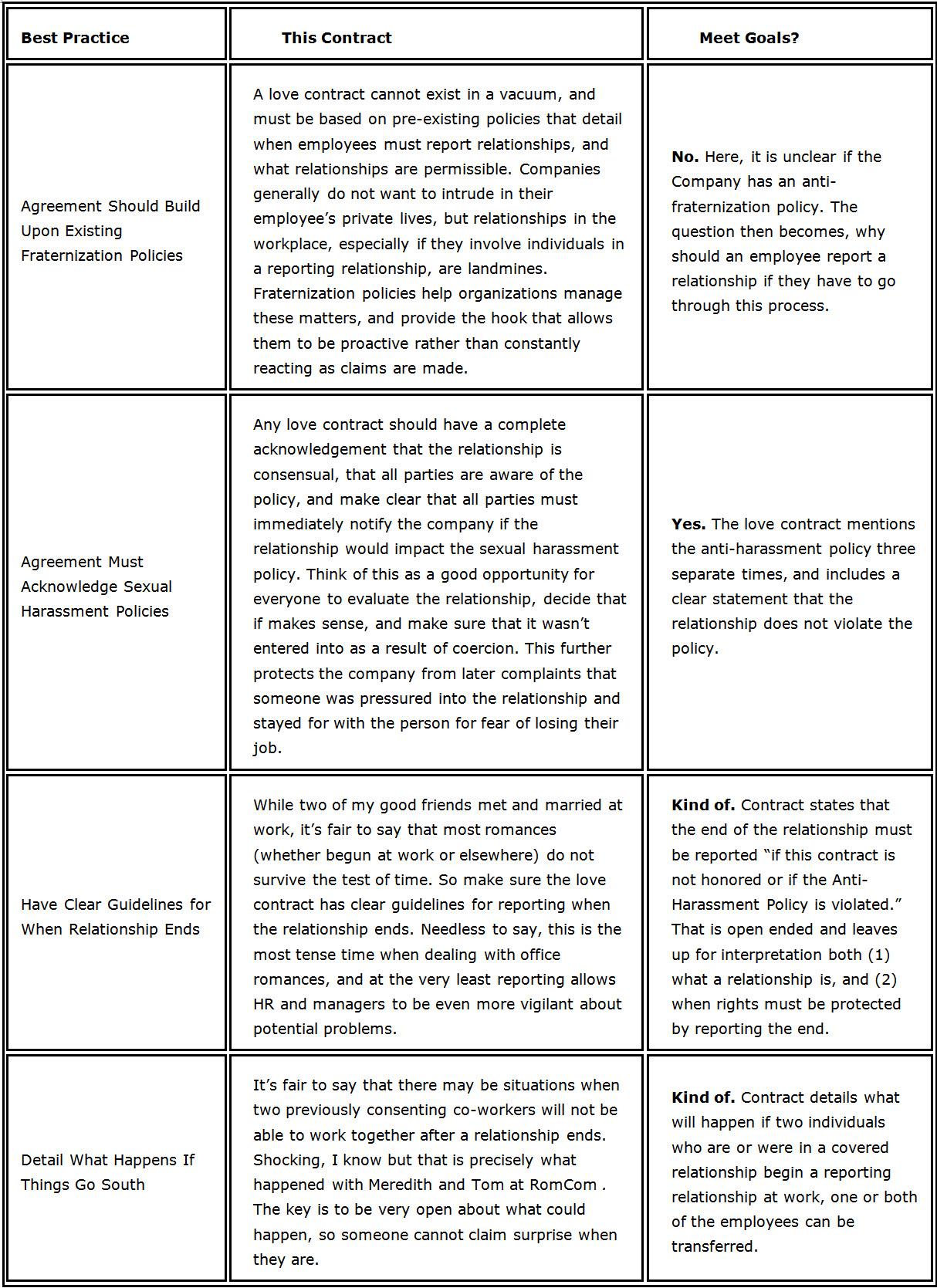
If Valentine’s Day leads to many office hookups, then April Fool’s Day can be considered the traditional day of mourning for imploded relationships. HR professionals fear April 2: the annual day of harassment complaints arising out of imploded workplace romances. Is there a solution to this cycle? The answer could lie in the admittedly unromantic “love contract.”

LoveContractsHere is one example of this type of agreement:

Tom Jones is employed by RomCom (the “Company”) as Head of Advanced Products Manufacturing. Meredith Smith is employed by RomCom as Head of the Advanced Products Division. Each hereby gives notice to RomCom of their voluntary social relationship.

In entering into this contract, each confirms the social relationship is entirely voluntary and consensual; that neither shall allow this relationship (or its termination) to negatively impact performance; and that each will respect the decision to end the relationship and will not engage in any unprofessional or inappropriate conduct toward the other either during or after this relationship. Specifically, each will not retaliate against the other person, engage in any unwanted efforts to resume the relationship, or engage in any other conduct toward the other person that could violate RomCom’s Anti-Harassment policy.

While working or on Company premises (including the premises of any business related to Company’s business), each commits to avoid any public displays of affection or other behavior that might interfere with the work of others, create a hostile work environment for others or that might make others feel uncomfortable. Each covenants to act professionally toward the employee named above at all times, even after the relationship has ended.

Each agrees to notify Human Resources if this contract is not honored or if the Anti-Harassment Policy is violated; to comply with all Company policies; and to refrain from any misrepresentations or omissions, in connection with any Company investigation or inquiry into such matters. Each understands and agrees that employment with RomCom may be terminated at any time, with or without cause.

Prior to signing this Consensual Reporting Relationship Form, each has received and reviewed the Company’s Sexual Harassment Policy, a copy of which is attached. By signing this agreement, each acknowledges that this social relationship does not violate RomCom’s Sexual Harassment Policy and that entering into the social relationship has not been made a condition or term of employment.

Each promises not to participate in any Company decision-making processes that could affect the pay, promotional opportunities, performance reviews, hours, shifts or career of the other, while in this relationship and after the relationship ends. Each acknowledges that RomCom will not permit a reporting relationship between those in a relationship and that it may require a transfer to avoid that conflict of interest and that, if a transfer is not available, one must resign; and that if neither resigns, RomCom will be permitted to terminate either.

Tom Jones and Meredith Smith have each read this Consensual Reporting Relationship Agreement, and by signing below, each agrees to comply fully with the terms of this Agreement.

_______________________________                      _______________________________

Employee (print name)                                               Employee (signature)

_______________________________                      _______________________________

Human Resources (print name)                                Human Resources (signature)

post

Bottom line, love contracts are certainly unsexy, and are sure to take much of the lust out of most office romances.

But, are these contracts a viable solution to a real problem? Sometimes, but not often. First, this is an option only for organizations with comprehensive policies in place. Second, even there, it is an option only for such entities where this approach fits the established culture of the organization. Finally, there is a perverse aspect to love contracts: the more you add, the more intrusive you will appear and the less likely people will choose to participate in this process: i.e., the death spiral between the legally desired protection and the voluntary co-operation needed to achieve that protection. Put simply, love contracts – like prenuptial agreements – aren’t for everybody.

Bring Your Own Device (“BYOD”) is a movement that is changing the IT landscape of workplaces.  In a BYOD workplace, employees use their own mobile device—smartphones, tablets, laptops, etc.—for both work and personal use.  Employees benefit from the dual use of a comfortable and known device while employers enjoy increased productivity and reduced technology costs.  Sounds like a win-win?  Not so fast.

Flip PhonesCourts are now catching up to BYOD with rulings to be considered in shaping BYOD policies.

Partitioning Work-Related Content from Personal Content?

Some employers have policies that allow it to wipe a device remotely if the device is lost or if the employee leaves the company’s employ.  In Rajaee v. Design Tech Homes, et al., the company remotely wiped the iPhone of a sales rep when he resigned.  This deleted all of the data—personal and work-related—and restored it to its factory settings.  This ex-employee brought suit under the ECPA (which makes it illegal to intentionally access electronic information without authorization) and CFAA (which, among other things, makes it unlawful to cause $5,000 or more in damage to electronically stored information).  This court rejected both claims, holding that the information in a cell phone is not “electronic storage” under the ECPA and that there was not a CFAA-qualified “loss” even though he lost all of his personal photos, videos, contacts and passwords.

Employers should review their BYOD policies and make sure that employees know the circumstances under which a device may be wiped.  Further, many companies are partitioning work-related content from personal content on their employees’ personal devices so when an employer needs to remotely wipe a lost or stolen device, it will do so only the corporate side of the wall.

Which Employees Should Be Part of a BYOD Policy?

Allowing nonexempt employees to use their own devices to conduct work-related business can lead to those employees racking up overtime by doing work anywhere and at any time, and later raising wage and hour claims for off-the-clock work.  For example, in Mohammadi v. Nwabuisi, an employer was found liable for not compensating an employee for overtime work performed on an employee-owned device.

In light of this decision and others like it, employers should consider either limiting BYOD to exempt employees or  re-developing time reporting systems/policies so that all time worked, (including time spent responding to after-hour emails and calls) is captured and paid.  White v. Baptist Memorial Health Care Corp., 699 F.3d 869 (6th Cir. 2012) (affirming summary judgment for employer because plaintiff failed to report time in exception logs; “[i]f an employer establishes a reasonable process for an employee to report uncompensated work time, the employer is not liable for non-payment if the employee fails to follow the established process”); Gaines v. K-Five Construction Corp., 2014 WL 28601, at *13 (7th Cir. 2014) (affirming summary judgment for employer; driver’s claims for pay for arriving early to perform pre-driving inspections insufficient where driver failed to properly fill out required forms to report extra time to payroll).

Reimbursing Your Employees for Their Devices?

While some employers partially reimburse their employees for using their personal devices for work purposes, recent studies show that the majority of employers do not.  This is a problem, especially in California. In Cochran v. Schwan’s Home Services Inc., the California Second District Court of Appeal held that California labor law requires employers to reimburse employees who are required to use their personal cell phones for work-related purposes for a reasonable percentage of their cellphone bill.  The court held that the reimbursement obligation is triggered even if employees do not incur any additional expense.

This may be a signal of what’s to come in other states given that California isn’t the only state with laws that require reimbursement for all necessary expenditures incurred by employees in discharging their work duties.  Plus, even in states with no such statutes, the argument will be made that the absence of reimbursement is an impermissible wage deduction.

BYOD vs Litigation Hold?

BYOD complicates the e-discovery process because electronic data that may fall within the scope of discovery requests can reside on devices besides those over which the company has control.  In the days before smartphones and cloud storage, receiving a litigation hold notice meant putting aside paper documents and turning off auto-delete on a custodian’s computer.  Now, however, it requires much more.

In Small v. Univ. Med. Center of S. Nevada, an eDiscovery special master recommended “death penalty” sanctions on the defendant for failing to preserve data stored on mobile devices.  The defendant failed to issue any litigation hold addressing BYOD devices despite the fact that several key employees confirmed that they used their personal mobile devices for work-related purposes.  As a result, defendant lost over two years of messages and other ESI that were potentially relevant to the litigation.  The special master declared the defendant’s conduct a “mockery of the orderly administration of justice,” and recommended that the court enter an order of default judgment.

Yesterday’s BYOD policy, in short, is as outdated as your uncle’s flip phone.

Multinationals are increasingly looking to take pay, bonus and benefits plans global. That can be tricky. Cautionary tales include hefty fines for neglecting to translate documents into a local language and court rulings holding discretionary language lost due to verbal commitment.

global compensation iStock_000046243362LargeHow can such unwelcome surprises be avoided? As Churchill put it, ”It is one thing to see the forward path and another to be able to take it.” To achieve the vision, there is much work to be done to understand, and therefore avoid, local pitfalls.

1. Understand Aftereffects

The risks of not tailoring to accommodate all of the international audiences are numerous and, frequently, costly. There is no one size fits all approach; a global plan requires a fine balance of the differing ways each location addresses compensation. The first thing to address is which company entity is leading the way. When deciding which entity will be responsible, a dangerous trap is to assume the parent. This may expose that entity to material risks, not only in the employment sphere (such as joint employer status), but also from tax and regulatory perspectives (such as permanent establishment). A possible solution is a “shadow payroll” where the local entity awards its own participants, then the parent funds and reimburses the local office.

2. Draft Precisely

Some countries like Belgium, France, Turkey and Saudi Arabia have mandatory translation requirements. Even if countries do not, compensation terminology can differ so much that it may seem like it requires translation. For example, particularly in Europe and Latin America, pay terminology can roll up base pay, bonuses, benefits and extras like vacation, overtime and 13th or even 14th month pay into the term “total compensation”. A poster child for this risk is the current line of case law in Europe concerning the elements that must be included in holiday pay. If you have not had recent experience with cross-cultural misinterpretation or need comic relief in your translation struggles, watch the Dirty Hungarian Phrasebook scene from Monty Python again.

3. Beware of Contractual Rights

Equally important is identifying jurisdictions where employees can acquire contractual rights even when a plan is “discretionary” or “one off”. In many countries, no matter how clearly terms are drawn, courts can interpret a plan to be contractual in practice. For example; if an ad hoc payment is repeated over a number of years, employees may acquire a right to ongoing payments. Employees may also argue that, although a scheme was discretionary, a certain sum was nevertheless promised. Brazil and Mexico have particular risks, changes that have a negative impact on employee compensation cannot be implemented, even if consent is obtained. To mitigate such risks, companies should: [A] ensure that discretion is actually exercised when making awards and payments do vary; [B] exercise caution when improving terms as this can be a route of no return; and [C] educate management to avoid verbal commitments or assurances that could undermine discretionary plans.

4. Consider Termination

In the United States, set off and claw back provisions are commonly triggered by certain employment terminations. Elsewhere, however, enforcing such termination-related clauses can be difficult, if not unlawful. Companies must also clarify whether payments will be made if participants are under “notice” of termination (as most jurisdictions outside the United States have statutory termination notice periods). Likewise, it is necessary to determine whether employees on garden leave are legally entitled to payments and whether pro rating payments or restricting participation of a specific group of employees (such those on protected leave or part-timers) is permitted under local law or forbidden as discriminatory.

5. Avoid Failure to Launch

Once the drafting is settled and the plan is vetted under the local laws of each country where it will be implemented, don’t get too comfortable. Implementation may require more work in each jurisdiction. For instance, consultation with trade unions, works councils, employee forums or individual employees is often required to roll out a new plan or to change an existing one.

We all know from Burns what can happen to the “best-laid schemes o’ mice an’ men”. There is no magic wand nor sprinkles of fairy dust to make global compensation plans instantaneously workable. Each requires an understanding of local impact. Fail to invest this time and such schemes can often go awry due to unexpected fines and adverse judicial rulings.

Growing up a Yankee fan, I hated Wade Boggs, the third baseman for the Boston Red Sox.  (Never mind for the moment that Boggs later played for the Yankees.)  Boggs controlled the tone of the game because he controlled the plate.  Pitchers knew that he wouldn’t swing at anything outside of the strike zone.  And umpires knew it, too.  So when Boggs stepped up, the narrative had already been set.Illustration of baseball player hitting baseball

Some recent class action work led me to think about Wade Boggs.  Defendants in employment class actions (arising under both discrimination and wage and hour statutes) should follow his lead.  As in baseball, success in class action litigation depends on setting an early tone and establishing a narrative.

Traditionally, class action plaintiffs set the narrative with defendants doing little to break it.  Thus, a defendant’s first opportunity to re-write a class narrative arose only in response to a motion for class certification.  And that opportunity followed months, if not years, of costly motion practice and discovery.

Wade Boggs wouldn’t play that way.  Neither should you.  Defendants can take hold of the class narrative at an earlier point in the case by filing a pre-discovery motion to strike class allegations from a complaint.

Federal Rule of Civil Procedure 12(f) permits motions to strike matter that is either “immaterial” or “impertinent.”  Accordingly, and in conjunction with Rule 23, a district court may consider a motion to strike class allegations at any “early practicable time after a person sues.”  Fed. R. Civ. P. 23(c)(1)(A); see Pilgrim v. Universal Health Card, LLC, 660 F.3d 943, 949 (6th Cir. 2011).  Simply stated, Rules 12(f) and 23 allow the court to ensure that neither it nor the parties waste resources resolving clearly spurious class disputes.

Boggs didn’t get to the Hall of Fame by wishing, but by consistent judgment.  That’s precisely what’s needed here.  A motion to strike is not an automatic response to every class action but a considered judgment that is proper only where “the complaint itself demonstrates that the requirements for maintaining a class action cannot be met,” no matter what or how much discovery is taken.  Landsman & Funk PC v. Skinder-Strauss Assocs., 640 F.3d 72, 93 n.30 (3d Cir. 2011); see also Cholakyan v. Mercedes-Benz USA, LLC, 796 F. Supp. 2d 1220, 1245-46 (C.D. Cal. 2011) (noting that it is rare to strike class allegations before discovery, and collecting cases).

So when does it make sense to move to strike class allegations?

  • Where class counsel represents two or more classes that bring claims against the same defendant.  When more than one class raises claims against a defendant with limited assets, it creates a potential conflict: the same dollar can’t be spent twice.  Thus, absent evidence that a defendant has sufficient assets to satisfy every class claim against it, a defendant can move to strike class allegations by pointing to class counsel’s representation of more than one of the classes.  See Ortiz v. Fibreboard Corp., 527 U.S. 815, 856 (1999); Lou v. Ma Labs, Inc., No. 12-5409 2014 WL 68605, at *2 (N.D. Cal. Jan. 8, 2014) (“When there are different plaintiffs in different actions proceeding at the same time with the same claims, same counsel, and same defendants, the risk of counsel compromising one class for another is intensified.”).
  • When the named plaintiff opted out in an earlier, related class action.  Of course, plaintiffs always have the right to opt out of a class and separately litigate their claims.  But plaintiffs cannot opt out, only to act as named plaintiffs in a subsequent and related class action.  See Johnson v. Nextel Commc’ns., Inc., 293 F.R.D. 660, 667-68 (S.D.N.Y. 2013).
  • Where it appears that named plaintiffs cannot prove ascertainability, numerosity, commonality, or predominance.  Courts generally disfavor motions to strike class allegations premised on an alleged inability to satisfy these Rule 23 elements.  And even where such motions are granted, they are typically granted with leave to amend.  See, e.g., Lyons v. Bank of Am., NA, No. 11-1232, 2011 WL 6303390, at *7 (N.D. Cal. Dec. 16, 2011).  But filing a motion to strike such allegations serves two important purposes: it draws the Court’s attention to class issues at an early stage of the proceedings and may help to narrow later argument and discovery.
  • When the parties need to frame settlement talks.  Experienced counsel understand that a pending motion to dismiss can set the stage for settlement by highlighting deficiencies in a plaintiff’s theory of the case and grounding damages expectations.  A pre-discovery motion to strike class allegations can serve the same purposes.  By highlighting the deficiencies in the named plaintiffs’ class allegations, a defendant can frame settlement negotiations by stressing the likelihood that the Court will not certify the class.

Ultimately, we don’t know what Wade Boggs would do if faced with any of these scenarios.  (Come to think of it, he’s no litigator; he’s not a lawyer; and he hasn’t played in in a major league baseball game since 1999.  Why are we still talking about him?  Because he overcame equinophobia or drank 107 beers in one day?)  But the lessons here are well taken, insofar as Boggs set the narrative for his career.

Or put another way, putative class action defendants would do well to ask themselves: what would Wade Boggs do?

Some start-ups are already doing it.  And, other companies are considering the cost-benefit analysis of allowing employees to bring their pets to work.  However, much like an unfamiliar dog, pet policies have to be handled with care.  Upsides (improved morale for and recruitment of pet lovers) are counterbalanced by downsides (allergies, phobias, or messes).  Thus, pet policies begin to micromanage (1) when, where and how often pets are allowed; (2) the types of pets; (3) grooming and behavior standards; and (4) who is liable for any pet-related damage – whether it be a dog bite or an oops in the hallway.

For pet-free employers, the problem arises when the office-Kim K. asserts that she needs to bring her lapdog to work because her pet Chihuahua is an “emotional support animal.”  This is a commonly abused status that pet-owners like to use – along with a note from a doctor – to take their pets anywhere for emotional support (see Pets Allowed, Patricia Marx, The New Yorker (last visited Jan. 31, 2015).

Under the Americans with Disabilities Act (“ADA”), employers – upon becoming aware of the need for accommodation  by a disabled employee – must engage in an interactive process to determine whether such request would be a reasonable accommodation.  That was certainly the case for “Sugar Bear,” the Shih-Tzu whose owner requested to bring him to work in order to ease symptoms of Chronic Ulcerative Proctitis and Ulcerative Colitis.  Assuming an actual request was made, the court held that the employer was obligated to consider whether the request for Sugar Bear to come into work was reasonable.  Assaturian v. Hertz Corp., No. CIV. 13-00299 DKW KS, 2014 WL 4374430, at *9 (D. Haw. Sept. 2, 2014) (denying employer’s motion for summary judgment on accommodation claim).

So far, the case law is evenly split in favor of or against allowing pets:

Yes-Pets No-Pets

Equal Employment Opportunity Comm’n v. AutoZone, Inc., No. CV061767PCTPGR, 2008 WL 4418160, at *4-5 (D. Ariz. Sept. 29, 2008) (ADA request by visually impaired employee to bring guide dog to work triggers need for an interactive process)

Schultz v. Alticor/Amway Corp., 177 F. Supp. 2d 674, 678-79 (W.D. Mich. 2001) (employer did not violate the ADA for refusing to allow employee to bring service dog to work, when “dog was not necessary for the performance of any essential function of [employee]’s job.”)


Branson v. West, No. 97 C 3538, 1999 WL 1186420, at *12 (N.D. Ill. Dec. 10, 1999) (doctor entitled to use service dog that pulled her wheelchair, opened doors, and picked up items; a power wheelchair, which aided mobility was not an adequate alternative to this dog)

Edwards v. U.S. E.P.A., 456 F. Supp. 2d 72, 98 (D.D.C. 2006) (request for accommodation deemed unreasonable where employee failed to demonstrate that bringing his untrained dog to work would resolve his stress and enable him to perform his job)

There is – as yet – no case law on when such accommodations constitute an undue burden.  For comparison, however, the Department of Justice regulations on the public accommodations section of the ADA suggest that “undue burden” may be difficult to prove.  For example, other employees’ allergies or fear of dogs are not valid reasons to deny access to service animals because the employer can just separate the allergic or fearful employees to different areas.  Conversely, service animals that fundamentally alter the nature of business operations; that cannot be controlled by their handler; that bite someone; or that are not housebroken would constitute an undue burden and may be denied.  See 28 C.F.R. §§ 35.130(b)(7), 35.136, 35.150(a)(3), 35.164, 36.301(b), 36.302 (c)(1), and 36.303(a).

Like other ADA accommodations, requests for service animal accommodations will vary on a case by case basis.  As our furry friends are increasingly invited to work, we expect to see more decisions defining when animals are allowed in the workplace.  When those requests arrive, consider  the Department of Justice’s regulations re public accommodations on what to ask at the outset of your interactive process: (1) is this animal is required because of a disability; and (2) what work or task has this animal been trained to perform.  See U.S. Department of Justice, Service Animals.